

Kalista, Registered Dental Hygienist
Why is having healthy gums so important?
One of the most common questions is why having healthy gums is so important, and the biggest thing is that oral health is connected to whole-body health, or what we call systemic health. If your gums are not healthy, that can have an impact beyond your mouth.
Gum disease involves inflammation and bacteria, and research has found associations between periodontal disease and several systemic health conditions, including heart disease, stroke, and cognitive conditions such as Alzheimer's disease and dementia. That's one of the many reasons it's important to take care of your gums as part of your overall health.
How can I know if my gums are healthy or unhealthy?
Some people ask how they can know if their gums are healthy or unhealthy, and one of the key signs I tell my patients to watch for is bleeding when you brush or floss. As long as you are not brushing or flossing too aggressively, bleeding can be a sign of inflammation in the gum tissue.
Plaque and bacteria around or under the gum tissue can contribute to inflammation. Sometimes soreness can happen, and some patients even describe an itchy feeling. Another thing to look for in the mirror is whether your gums appear puffy, swollen, or red, which can also be signs of inflammation.
Can unhealthy gums be fixed?
A question we often get asked here in the office is whether unhealthy gums can be treated, and yes, that is exactly what we are here for at Smiles By Design. We will perform a full exam, see how your gums are looking, and determine what kind of cleaning or treatment is necessary to help get your gums back to a healthier state.
A big part of that, though, is working on your home care as well. Brushing, flossing, and following the recommendations we give you can all help maintain healthier gums.
What is a deep cleaning?
Another big question we get is about deep cleanings. When plaque and tartar have accumulated below the gum line and there are signs of gum disease, a deep cleaning may be necessary to thoroughly clean below the gums.
What that entails is getting you nice and comfortable. We can use numbing gel and local anesthetic when needed to help keep you comfortable. Then we use a combination of specialized instruments and sometimes water-based tools to clean underneath the gum tissue and around the roots of the teeth.
Why do I need more than one cleaning?
Oftentimes, when you have not had a cleaning in a long time, you may wonder why you need more than one appointment to have your teeth completely cleaned. The way I explain that to people is, especially if you have not had a cleaning in, let's say, two years, you are essentially making up for several missed cleanings.
Sometimes one one-hour appointment cannot address all the plaque and buildup that has accumulated over that time. When you have a lot of buildup, it can take longer, especially with deep cleanings. If you have not been in for five or 10 years, we may simply need some extra time to make sure we clean everything thoroughly because we do not want to leave anything behind.
Are deep cleanings painful?
One of the biggest questions I get chairside, and honestly out in the wild world, is whether deep cleanings are painful. When you are having them done, our goal is to make you as comfortable as possible. We can get you numb, and if you need additional numbing during treatment, we can provide it to help keep you comfortable.
Afterward, some soreness of the gum tissue can be normal, but for most patients, it improves within a day or two. We will also give you instructions for managing any discomfort after your treatment.
How do I take care of my gums after treatment?
Patients often ask me how to take care of their gums after we have done all the work here in the office. Some of the biggest things I recommend to my patients are a power toothbrush, a water flosser, and routine daily flossing with a floss that works comfortably between your teeth.
Removing plaque and bacteria every day is one of the best ways to help keep your gums healthy. Sometimes, if your gums are really inflamed, I may recommend a salt water rinse as well. But the biggest thing is staying consistent with flossing, using your water flosser, brushing thoroughly, and following the home-care recommendations we give you.
What causes gum recession?
Outside of swollen tissue and inflamed gums, a lot of my patients ask me about gum recession as well. Gum recession can happen for a variety of different reasons. Brushing too aggressively, using a toothbrush with hard bristles, and a history of periodontal disease or gum disease can all contribute to recession and loss of gum tissue.
There are things that can help protect your gums, whether that's using a power toothbrush with a pressure sensor or switching to a soft or extra-soft toothbrush. In instances where patients have significant recession, I usually have the doctor come in to evaluate the area and determine whether a treatment such as gum grafting may be appropriate. We can give you more information about your options when you come in for your appointment.
If you’re looking for dental care you can trust, call us at 315-474-1711 or email [email protected]. We’re here to help you have the smile you've always wanted!
Gum Disease Treatment in Syracuse, NY
Periodontal disease can affect one tooth or many teeth. It begins when the bacteria in plaque (the sticky, colorless film that constantly forms on your teeth) causes the gums to become inflamed and/or have a bacterial smell.
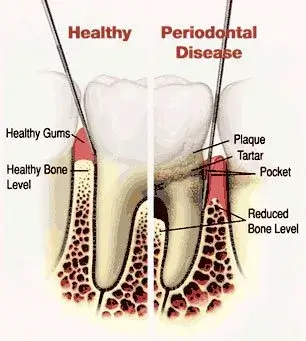
Gingivitis is the mildest form of the disease, where the gums can redden, swell and bleed easily. There is usually little or no discomfort. Gingivitis is often caused by inadequate oral hygiene. Gingivitis is reversible with professional treatment to periodontitis. With time, plaque can spread and grow below the gum line.
Toxins produced by the bacteria in plaque irritate the gums. The body in essence turns on itself, and the tissues and bone that support the teeth are broken down and destroyed.
Gums separate from the teeth, forming pockets (spaces between the teeth and gums) that become infected. As the disease progresses, the pockets deepen and more gum tissue and bone are destroyed. Often, this destructive process has very mild to almost no symptoms. Think of it as if bugs are eating away at the soil around a tree trunk. Eventually, they eat away all of the soil and part of the tree’s roots, causing the tree to collapse.
I Would Like to Make a Gum Disease Treatment Visit
How To Keep a Healthy Smile for Life
For a healthy smile it is important to keep both your gums and teeth healthy. The best way to do this is to see your dentist and hygienist every 6 months and do the treatment that you need that has been recommended for you.

Treatment of Periodontal Disease
Periodontal health should be achieved in the least invasive and most cost-effective manner. This is often accomplished through non-surgical periodontal treatment, including scaling and root planning (a careful deep cleaning of the root surfaces to remove plaque and calculus (tartar) from deep periodontal pockets and to smooth the tooth root to remove bacterial toxins).
Most dentists and specialists would agree that after scaling and root planning, many patients do not require any further active treatment, including surgical intervention. However, the majority of patients will require ongoing maintenance therapy to sustain health. Non-surgical therapy does have its limitations, however, and when it does not achieve periodontal health, surgery may be indicated to restore periodontal anatomy damaged by periodontal diseases and to facilitate oral hygiene practices.